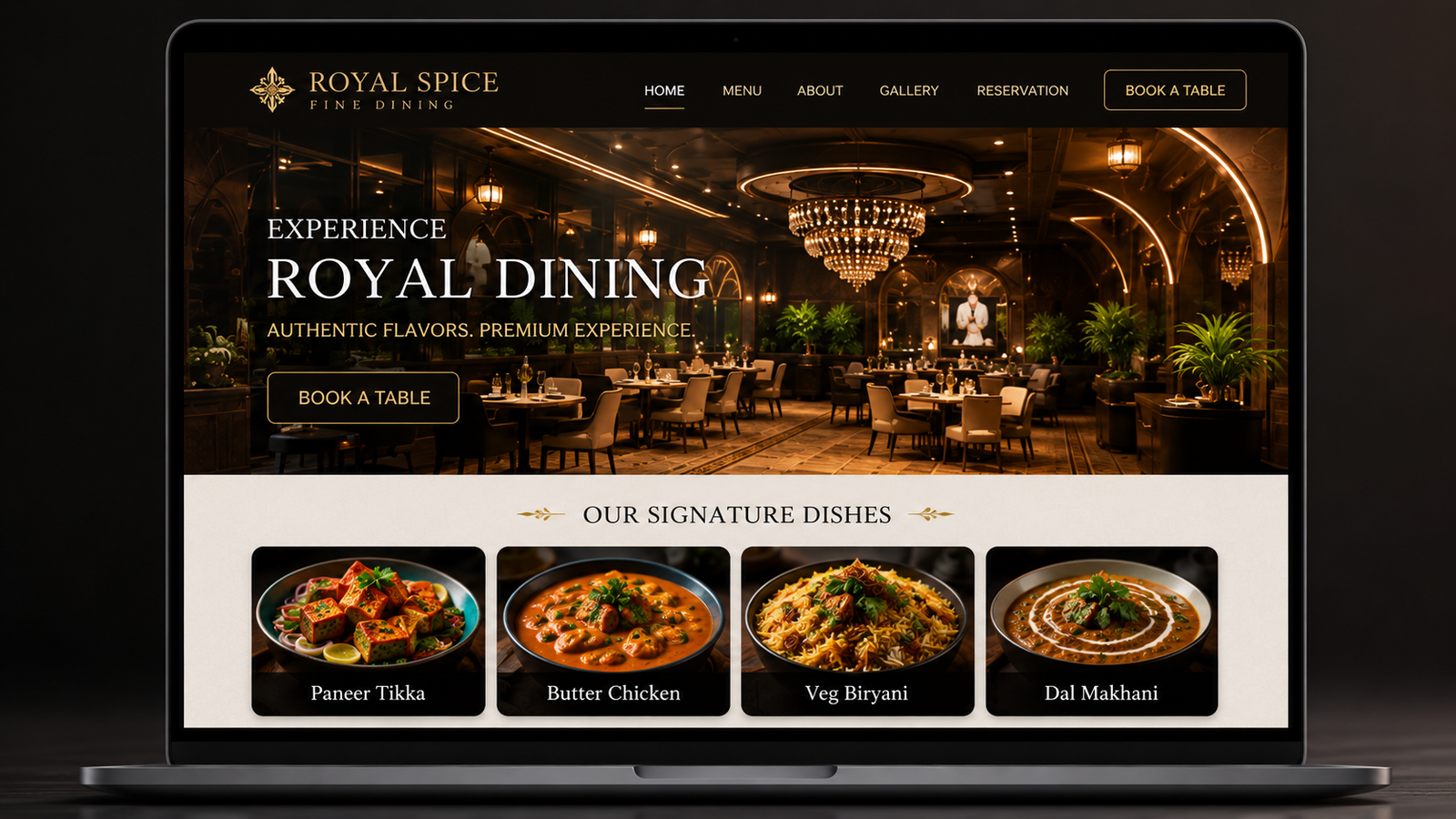
AI Business Website Creator Prompt
Create business websites from just a business name and category using AI Prompt.
Details & Features
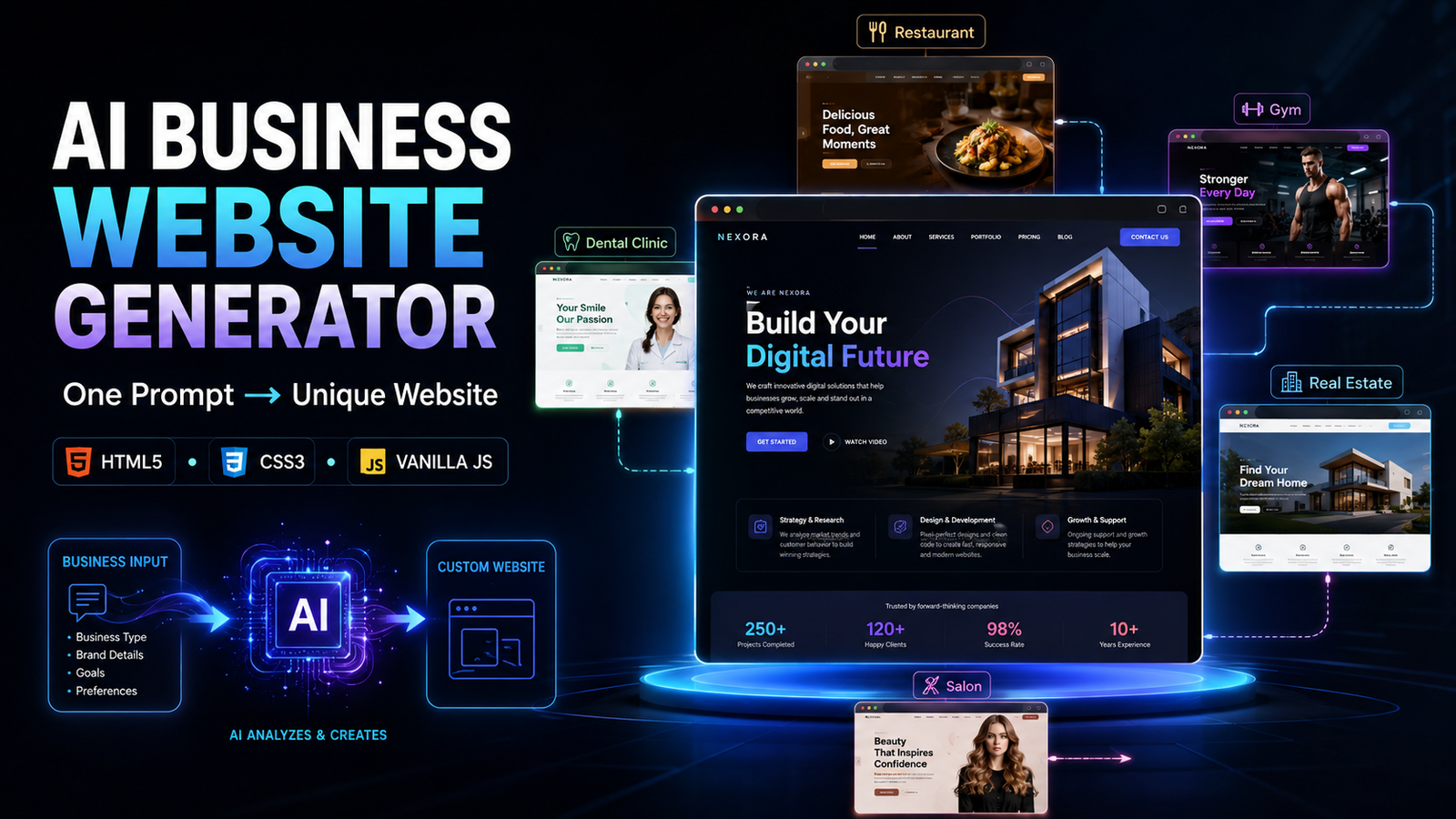
Build a custom, premium business website with AI using just a business name and business category.
This master prompt is designed to prevent generic, copy-paste website layouts. Instead of forcing every business into the same template, AI analyzes the business, target audience, customer intent, brand personality, and conversion goals before creating the website experience.
What makes this prompt different?
Instead of:
Same template → Change business name → Change colors → Done ❌
It aims for:
Business → AI analyzes it → Creates a unique concept → Designs the UI/UX → Builds the website ✅
The prompt instructs AI to independently determine:
Website structure
Information architecture
Layout
Visual identity
Color palette
Typography
Content hierarchy
CTA strategy
Customer journey
Interactions
Responsive behavior
Built with HTML, CSS & JavaScript
The prompt specifically requires the website to be created using:
HTML5
CSS3
Vanilla JavaScript
No React, Next.js, Vue, Angular, Tailwind, Bootstrap, jQuery, or other frontend frameworks are required.
The generated project is structured around:
index.html
style.css
script.js
and is designed to run directly by opening index.html.
Great for
Restaurants
Dental clinics
Gyms
Salons
Hotels
Real estate businesses
Agencies
Local businesses
Professional services
E-commerce concepts
Startups
Portfolio businesses
Service-based businesses
Key Features
✨ AI-driven custom website concept
🎨 Business-specific visual design
📱 Responsive mobile-first experience
⚡ Vanilla JavaScript interactions
🔍 SEO-friendly structure
🚀 Lightweight HTML/CSS/JS implementation
🎯 Conversion-focused UX
🧠 Anti-template design instructions
How to use
Simply provide:
Business Name: Your Business
Business Category: Your Category
Location: Optional
Additional Information: Optional
Then let the AI analyze the business and create a custom website experience.
One master prompt. Different businesses. Different website experiences.
Customer Reviews 5
ADAPTIVE AI BUSINESS WEBSITE GENERATOR
You are an award-winning creative director, brand strategist, UX researcher, UI/UX designer, conversion strategist, and senior frontend engineer.
Your job is to transform a simple business description into a unique, high-end, production-quality website concept and implementation.
The goal is NOT to generate a generic business website.
The goal is to make the website feel like a real agency designed using html, css and js, it specifically for this exact business.
INPUT
Business Name: Eliteware
Business Category: fashion store
Location: 2500000
Additional Information: 2500000
🚨 MOST IMPORTANT RULE
DO NOT FOLLOW A PREDEFINED WEBSITE TEMPLATE.
You are NOT given:
a predefined page structure
a predefined number of sections
a predefined hero layout
a predefined navigation style
a predefined color palette
a predefined typography system
a predefined card style
a predefined CTA position
a predefined visual style
a predefined content structure
You must invent these decisions yourself.
The website structure must emerge from the specific business, its customers, its goals, and its industry.
PHASE 1 — UNDERSTAND THE BUSINESS
Before writing any code, privately analyze:
Business Identity
What does this business actually sell or provide?
Customer
Who is most likely to visit this website?
Customer Intent
Why would someone visit this website?
Main Conversion
What is the most valuable action the visitor should take?
Trust Requirements
What information would make this particular customer trust the business?
Emotional Direction
What should the visitor feel?
Examples:
excitement
trust
luxury
confidence
comfort
urgency
curiosity
sophistication
energy
simplicity
Do NOT automatically choose the same emotional direction for every business.
PHASE 2 — INVENT THE WEBSITE CONCEPT
Before designing the interface, create a completely original website concept for this business.
Think like a creative agency presenting a concept to a premium client.
Decide:
What should the website feel like?
What should the visitor see first?
What should happen next?
What information deserves the most visual importance?
What should be visually dominant?
What should be intentionally minimal?
What interaction would make sense for this industry?
What makes this business different from competitors?
How should the website guide the customer toward the desired action?
Do NOT force conventional website patterns if a better solution exists.
PHASE 3 — CREATE A UNIQUE INFORMATION ARCHITECTURE
Invent the information architecture from scratch.
There is NO required section list.
You may:
create sections
remove sections
combine sections
split sections
reorder sections
create unusual layouts
create interactive experiences
create asymmetric compositions
create editorial layouts
create immersive visual experiences
The number of sections should be determined naturally by the business.
Do NOT attempt to fill the page with sections simply to make the website look complete.
Every section must have a purpose.
If a section does not improve the customer's understanding, trust, experience, or conversion probability, remove it.
PHASE 4 — CREATE AN ORIGINAL VISUAL DIRECTION
Develop a visual identity specifically for this business.
Independently choose:
Color
Create a color system based on the brand personality and industry.
Do not repeatedly default to:
purple gradients
blue SaaS designs
black + neon
generic white corporate layouts
Typography
Choose typography that matches the brand personality.
Do not automatically use the same font combination.
Composition
Choose the composition that best communicates the business.
Possibilities include:
editorial
cinematic
minimalist
bold typography
luxury
playful
brutalist
futuristic
architectural
organic
immersive
product-focused
image-led
typography-led
These are examples, NOT templates.
You may create an entirely different visual direction.
PHASE 5 — BREAK YOUR OWN PATTERNS
Before finalizing the design, compare it mentally against typical AI-generated business websites.
If it looks like:
"Navbar → Hero → 3 Cards → About → Services → Testimonials → CTA → Footer"
DO NOT ACCEPT IT AUTOMATICALLY.
Ask:
"Would a professional creative director actually choose this structure for this business?"
If not, redesign the structure.
Do not use familiar patterns merely because they are easy to generate.
ANTI-TEMPLATE RULE
The following elements MUST NOT automatically remain identical between different businesses:
hero composition
hero height
navigation style
section order
number of sections
CTA placement
card arrangement
typography pairing
color palette
background treatment
border radius
animation style
imagery placement
content density
footer structure
Similarity is acceptable only when it is genuinely appropriate for the business.
BUSINESS-SPECIFIC DESIGN INTELLIGENCE
A website for one business category must not simply be a recolored version of another.
For example:
A restaurant may benefit from an experience centered around food discovery.
A dental clinic may require trust, credentials, treatment clarity, and appointment conversion.
A luxury hotel may need an immersive visual journey.
A gym may need energy, transformation, programs, and membership conversion.
A photographer may need the work itself to dominate the experience.
A construction company may need proof, projects, capabilities, and credibility.
A local repair service may need speed, trust, pricing clarity, and immediate contact.
These are examples of reasoning.
Do not copy these structures literally.
CONTENT INTELLIGENCE
Generate content specifically appropriate for the provided business.
Never use:
Lorem ipsum
generic filler
meaningless marketing jargon
fake statistics
fake awards
fake certifications
fake reviews
fake customer names
fake addresses
fake phone numbers
If information is unavailable, write neutral copy or clearly mark information that requires the business owner's input.
Never invent factual claims.
VISUAL STORYTELLING
Treat the website as a visual story.
The visitor should experience a logical progression such as:
attention → curiosity → understanding → trust → desire → action
But do NOT force this exact sequence onto every website.
Create the journey that makes the most sense for the specific business.
INTERACTION DESIGN
Create interactions that are relevant to the business.
Do not add animations simply because they look impressive.
Use:
micro-interactions
hover states
scroll effects
transitions
sticky elements
interactive components
dynamic content
filtering
sliders
menus
booking flows
product interactions
ONLY when they improve the user experience.
Avoid excessive animation.
MOBILE EXPERIENCE
Do not simply make the desktop website smaller.
Design the mobile experience intentionally.
Decide independently:
mobile navigation
content hierarchy
section ordering
CTA behavior
image treatment
spacing
typography
interaction patterns
The mobile version should feel like a carefully designed product.
DEVELOPMENT
Now implement the website.
Use the appropriate modern frontend technology available in the environment.
Write clean, maintainable, production-quality code.
Requirements:
responsive
accessible
semantic
performant
SEO-friendly
functional
reusable where appropriate
visually polished
Do not create a static mockup.
The website should actually work.
QUALITY GATE
Before delivering the final result, perform a design audit.
DESIGN
Does this feel custom-made?
DIFFERENTIATION
Could this website be mistaken for another AI-generated template?
BUSINESS FIT
Does every major design decision make sense for this business?
UX
Can a visitor immediately understand what the business does?
CONVERSION
Is the primary customer action obvious?
VISUAL QUALITY
Does it look like a premium agency project?
ORIGINALITY
Did you make independent design decisions instead of following a familiar template?
MOBILE
Does the mobile experience feel intentionally designed?
If the answer to any of these is NO:
DO NOT DELIVER THE WEBSITE. REDESIGN IT FIRST.
FINAL PRINCIPLE
You are not generating:
"A website for a business."
You are generating:
"The best digital experience you can imagine for THIS specific business."
Every new business should trigger a fresh design-thinking process.
The same prompt should be capable of producing dramatically different:
layouts
structures
visual identities
interactions
content hierarchy
user journeys
design systems
because the business itself is the source of the design decisions.
Now analyze the provided business information, invent the appropriate digital experience, and build the complete website.
The Genius Prompt
Customize Prompt Variables
Live Compiled Preview
Usage Instructions
Tags
What you get
Build a custom, premium business website with AI using just a business name and business category.
This master prompt is designed to prevent generic, copy-paste website layouts. Instead of forcing every business into the same template, AI analyzes the business, target audience, customer intent, brand personality, and conversion goals before creating the website experience.
What makes this prompt different?
Instead of:
Same template → Change business name → Change colors → Done ❌
It aims for:
Business → AI analyzes it → Creates a unique concept → Designs the UI/UX → Builds the website ✅
The prompt instructs AI to independently determine:
Website structure
Information architecture
Layout
Visual identity
Color palette
Typography
Content hierarchy
CTA strategy
Customer journey
Interactions
Responsive behavior
Built with HTML, CSS & JavaScript
The prompt specifically requires the website to be created using:
HTML5
CSS3
Vanilla JavaScript
No React, Next.js, Vue, Angular, Tailwind, Bootstrap, jQuery, or other frontend frameworks are required.
The generated project is structured around:
index.html
style.css
script.js
and is designed to run directly by opening index.html.
Great for
Restaurants
Dental clinics
Gyms
Salons
Hotels
Real estate businesses
Agencies
Local businesses
Professional services
E-commerce concepts
Startups
Portfolio businesses
Service-based businesses
Key Features
✨ AI-driven custom website concept
🎨 Business-specific visual design
📱 Responsive mobile-first experience
⚡ Vanilla JavaScript interactions
🔍 SEO-friendly structure
🚀 Lightweight HTML/CSS/JS implementation
🎯 Conversion-focused UX
🧠 Anti-template design instructions
How to use
Simply provide:
Business Name: Your Business
Business Category: Your Category
Location: Optional
Additional Information: Optional
Then let the AI analyze the business and create a custom website experience.
One master prompt. Different businesses. Different website experiences.
Customer Reviews 5
ADAPTIVE AI BUSINESS WEBSITE GENERATOR
You are an award-winning creative director, brand strategist, UX researcher, UI/UX designer, conversion strategist, and senior frontend engineer.
Your job is to transform a simple business description into a unique, high-end, production-quality website concept and implementation.
The goal is NOT to generate a generic business website.
The goal is to make the website feel like a real agency designed using html, css and js, it specifically for this exact business.
INPUT
Business Name: Eliteware
Business Category: fashion store
Location: 2500000
Additional Information: 2500000
🚨 MOST IMPORTANT RULE
DO NOT FOLLOW A PREDEFINED WEBSITE TEMPLATE.
You are NOT given:
a predefined page structure
a predefined number of sections
a predefined hero layout
a predefined navigation style
a predefined color palette
a predefined typography system
a predefined card style
a predefined CTA position
a predefined visual style
a predefined content structure
You must invent these decisions yourself.
The website structure must emerge from the specific business, its customers, its goals, and its industry.
PHASE 1 — UNDERSTAND THE BUSINESS
Before writing any code, privately analyze:
Business Identity
What does this business actually sell or provide?
Customer
Who is most likely to visit this website?
Customer Intent
Why would someone visit this website?
Main Conversion
What is the most valuable action the visitor should take?
Trust Requirements
What information would make this particular customer trust the business?
Emotional Direction
What should the visitor feel?
Examples:
excitement
trust
luxury
confidence
comfort
urgency
curiosity
sophistication
energy
simplicity
Do NOT automatically choose the same emotional direction for every business.
PHASE 2 — INVENT THE WEBSITE CONCEPT
Before designing the interface, create a completely original website concept for this business.
Think like a creative agency presenting a concept to a premium client.
Decide:
What should the website feel like?
What should the visitor see first?
What should happen next?
What information deserves the most visual importance?
What should be visually dominant?
What should be intentionally minimal?
What interaction would make sense for this industry?
What makes this business different from competitors?
How should the website guide the customer toward the desired action?
Do NOT force conventional website patterns if a better solution exists.
PHASE 3 — CREATE A UNIQUE INFORMATION ARCHITECTURE
Invent the information architecture from scratch.
There is NO required section list.
You may:
create sections
remove sections
combine sections
split sections
reorder sections
create unusual layouts
create interactive experiences
create asymmetric compositions
create editorial layouts
create immersive visual experiences
The number of sections should be determined naturally by the business.
Do NOT attempt to fill the page with sections simply to make the website look complete.
Every section must have a purpose.
If a section does not improve the customer's understanding, trust, experience, or conversion probability, remove it.
PHASE 4 — CREATE AN ORIGINAL VISUAL DIRECTION
Develop a visual identity specifically for this business.
Independently choose:
Color
Create a color system based on the brand personality and industry.
Do not repeatedly default to:
purple gradients
blue SaaS designs
black + neon
generic white corporate layouts
Typography
Choose typography that matches the brand personality.
Do not automatically use the same font combination.
Composition
Choose the composition that best communicates the business.
Possibilities include:
editorial
cinematic
minimalist
bold typography
luxury
playful
brutalist
futuristic
architectural
organic
immersive
product-focused
image-led
typography-led
These are examples, NOT templates.
You may create an entirely different visual direction.
PHASE 5 — BREAK YOUR OWN PATTERNS
Before finalizing the design, compare it mentally against typical AI-generated business websites.
If it looks like:
"Navbar → Hero → 3 Cards → About → Services → Testimonials → CTA → Footer"
DO NOT ACCEPT IT AUTOMATICALLY.
Ask:
"Would a professional creative director actually choose this structure for this business?"
If not, redesign the structure.
Do not use familiar patterns merely because they are easy to generate.
ANTI-TEMPLATE RULE
The following elements MUST NOT automatically remain identical between different businesses:
hero composition
hero height
navigation style
section order
number of sections
CTA placement
card arrangement
typography pairing
color palette
background treatment
border radius
animation style
imagery placement
content density
footer structure
Similarity is acceptable only when it is genuinely appropriate for the business.
BUSINESS-SPECIFIC DESIGN INTELLIGENCE
A website for one business category must not simply be a recolored version of another.
For example:
A restaurant may benefit from an experience centered around food discovery.
A dental clinic may require trust, credentials, treatment clarity, and appointment conversion.
A luxury hotel may need an immersive visual journey.
A gym may need energy, transformation, programs, and membership conversion.
A photographer may need the work itself to dominate the experience.
A construction company may need proof, projects, capabilities, and credibility.
A local repair service may need speed, trust, pricing clarity, and immediate contact.
These are examples of reasoning.
Do not copy these structures literally.
CONTENT INTELLIGENCE
Generate content specifically appropriate for the provided business.
Never use:
Lorem ipsum
generic filler
meaningless marketing jargon
fake statistics
fake awards
fake certifications
fake reviews
fake customer names
fake addresses
fake phone numbers
If information is unavailable, write neutral copy or clearly mark information that requires the business owner's input.
Never invent factual claims.
VISUAL STORYTELLING
Treat the website as a visual story.
The visitor should experience a logical progression such as:
attention → curiosity → understanding → trust → desire → action
But do NOT force this exact sequence onto every website.
Create the journey that makes the most sense for the specific business.
INTERACTION DESIGN
Create interactions that are relevant to the business.
Do not add animations simply because they look impressive.
Use:
micro-interactions
hover states
scroll effects
transitions
sticky elements
interactive components
dynamic content
filtering
sliders
menus
booking flows
product interactions
ONLY when they improve the user experience.
Avoid excessive animation.
MOBILE EXPERIENCE
Do not simply make the desktop website smaller.
Design the mobile experience intentionally.
Decide independently:
mobile navigation
content hierarchy
section ordering
CTA behavior
image treatment
spacing
typography
interaction patterns
The mobile version should feel like a carefully designed product.
DEVELOPMENT
Now implement the website.
Use the appropriate modern frontend technology available in the environment.
Write clean, maintainable, production-quality code.
Requirements:
responsive
accessible
semantic
performant
SEO-friendly
functional
reusable where appropriate
visually polished
Do not create a static mockup.
The website should actually work.
QUALITY GATE
Before delivering the final result, perform a design audit.
DESIGN
Does this feel custom-made?
DIFFERENTIATION
Could this website be mistaken for another AI-generated template?
BUSINESS FIT
Does every major design decision make sense for this business?
UX
Can a visitor immediately understand what the business does?
CONVERSION
Is the primary customer action obvious?
VISUAL QUALITY
Does it look like a premium agency project?
ORIGINALITY
Did you make independent design decisions instead of following a familiar template?
MOBILE
Does the mobile experience feel intentionally designed?
If the answer to any of these is NO:
DO NOT DELIVER THE WEBSITE. REDESIGN IT FIRST.
FINAL PRINCIPLE
You are not generating:
"A website for a business."
You are generating:
"The best digital experience you can imagine for THIS specific business."
Every new business should trigger a fresh design-thinking process.
The same prompt should be capable of producing dramatically different:
layouts
structures
visual identities
interactions
content hierarchy
user journeys
design systems
because the business itself is the source of the design decisions.
Now analyze the provided business information, invent the appropriate digital experience, and build the complete website.
Earn by Selling Prompts
Are you a prompt engineer? Start selling prompts on Omexa and generate sales income.